Archimedia Studios

  • Home
  • Our Company
  • Expertise
  • Blog
  • Contact Us

The End of Marketing?

March 9, 2011

Lately we hear much talk about the death of marketing, how easy it is for someone to set up a Facebook account, write a few Tweets and build a brand without the need for a professional marketer.

Really?

When is the last time you watched a commercial? Have you seen a magazine or newspaper in the last week? Did any direct mail make it to your mailbox this month? Was there an ad in your iPhone app? Did your grocery store print coupons when you checked out? Did you drive past any billboards on your way to work? Did your DVD have trailers? Was there a commercial during your Hulu movie?

In comparing marketing to food – it is like a carefully planned and constructed seven-course gourmet banquet, rather than a simple bologna sandwich.

Marketing channels

Online marketing is valuable. The instantaneous nature of the Internet makes marketing online a tool that provides high ROI and quick conversion. However, online marketing is just one  course served at the banquet.

There are many dishes served in that online marketing course including:

  • Article marketing
  • Video marketing
  • Email marketing
  • Websites
  • Blogs
  • Social Media
  • Backlinking…

Offline marketing is no less valuable. Brand awareness and recognition often begins with a commercial, a carefully placed ad in the mall, a radio or television spot. The offline course may not suit all tastes, but no feast is complete without them, and that course often provides the dish people first recognize and associate with comfort and tradition.

Marketing is rich; the tastes are varied and distinct. Understanding how those subtle and complex tastes work together and affect each other is the difference between marketing in a silo and building holistic campaigns. It is also the difference between the amateur and his Facebook page and the indelible mark created by a brand that is well built.


Filed Under: Marketing Insights

List Segmentation important to know how to use it

March 1, 2011

Do you collect email addresses on your webaite or third party sites such as Reverbnation?  Are you maximizing this information to increase your sales?

Put simply, list segmentation targets your communications and increases the relevancy of your messages—resulting in higher open and click-through rates, enhanced customer loyalty, and increased sales. In email marketing, the more relevant your campaign is, the better the response and the greater the conversions.

The advantages of segmentation are obvious, and if it’s done correctly you can avoid opt-outs and being labeled a spammer. It also goes a long way toward improving your email deliverability and online reputation. Marketers who send relevant email campaigns enjoy lower opt-out rates than those who send the same email to everyone on their list.

Of course, segmenting your precious lists can be an unnerving task, especially if you have never attempted it before. Below are some of the most effective methods of segmentation, but don’t panic—you don’t need to try them all at once. Just start with the information you have, and work your way from there.

Your segmentation can be based on any combination of the following criteria:

  • Prospective Customers vs. Current Customers. This is an important segmentation. What you will avoid is having a customer receive an email as if he or she were a prospect, offering better deals than the ones customers were offered. It’s a bad move, and the customer won’t trust that he or she is unique in your eyes.
  • Demographics (ZIP/postal code, gender, age, occupation). If your subscriber lives in New York, why are you sending her specials about flights between Texas and Alaska? Or if your subscriber is a 25-year-old woman, why are you sending her emails for specials on “Fashions for Mature Women”? You get the idea. Take note of demographics, and your relevant emails will give your subscriber the impression that you are listening (which you are) and will help garner the results you seek.
  • Behavioral Data. Open and click-through rates, latest or last visit—that type of information can help you target who is more responsive to your emails. The subscribers who open your emails all the time or regularly can perhaps be tested with receiving more frequent emails.
  • Recent Subscribers. Recent could be 3-6 months, or it could be since the last campaign you sent a month ago. Either way, the “newbies” should be separated and paid special attention to; don’t be so quick to finish the “courting period.” You could offer more deals or discounts on your products or services, thereby giving them the feeling that you haven’t just “loved them and left them.”
  • Inactive Subscribers. Any subscriber who hasn’t opened or clicked on your email over an extended period of time can be deemed “inactive.” Instead of writing them off as a lost cause, put them into a separate group and send them a targeted reactivation campaign in the near future.
  • Preference Surveys /Interest-Based Preferences. Don’t be scared to ask for information you don’t have, such as new interests and updated email addresses. Tell customers that it will help you send more relevant emails, and remind them that you will maintain their privacy at all cost.
  • Major Clients. Anyone who spends more than $1,000 at a given time, while others spend less than $100, should always get special attention. Offer platinum status, free shipping, or gifts with their next purchase—anything that makes your customers think you appreciate their loyalty, which you do, of course.
  • Purchasing Habits. Another great way to segment is by identifying what type of product your customers bought, how much they spent, and which store they bought from. Your next email might read, “This week, 25% discount on all clothing/baby goods/garden equipment over $50 at our Portland branch.”

Once you have segmented your lists (no matter how extensively), it’s vital to keep the categories up to date. Schedule a regular date to review your segments, annually or bi-annually (at least). Look at what campaigns each customer is opening and consider re-categorizing them, if necessary. But before you re-categorize them, ask them—in an email—what they are interested in, and let them choose their own categories.

Filed Under: Marketing Insights

Signs You Are Too Plugged In To Social Media

March 1, 2011

In our increasingly “plugged in” culture there are some who question whether it is possible to become too plugged in.

You know you are too plugged in to Social Media if…..

1. You think a water proof iPhone for the shower or tub makes sense

2. You have tweeted during sex

3. You believe the “actual physical real world” is just an accessory to your online life – When you get big news and the first thing you think of is “I can’t wait to share this on Facebook”, you might be in danger.

4. When you “laugh out loud” you actually say “LOL”

5. You believe your keyboard makes a good pillow

6. You text during a movie in theaters and actually believe no one sees the light from your phone

7. If your friends or family aren’t on Facebook or Twitter, you rarely speak to them

Filed Under: Social Media Marketing

Another Easy Way to Manage Multiple Social Media Accounts

February 25, 2011

It’s not easy navigating a multiplicity of social media accounts for yourself and a client—sometimes multiple clients—at the same time.

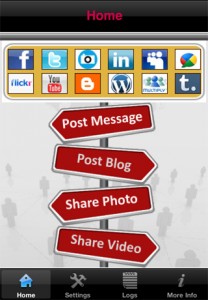
But thumbs up! The super-helpful iPhone app MySocialMania doesn’t just keep you connected to all your social nets on the go, it also cross-updates messages and photos on multiple sites at once, including:

  • Facebook, MySpace, LinkedIn
  • Twitter, Friendster, Google Buzz
  • Even WordPress, Blogger, Tumblr, among others.

While there are other similar apps on the market such as Ping.FM and Hootsuite, MySocialMania is certainly another entry to check out. Remember, use what is most comfortable and most efficient for your needs and social media strategy!

MySocialMania is available on iPhone, iPod touch and iPad. You’ll find it in the App Store under Social Networking.

Looks like an interesting app, but our concern is that it is so focused on talking – to the nearly complete exclusion of listening.  It is important to remember that connecting is more than just pushing your own content into the cloud. However, as a tool of convenience to get your message out to as many mediums as possible at one time, this app may do the trick.

Filed Under: Social Media Marketing

Are your Facebook posts being seen?

February 24, 2011

Not all friends are created equal. This is something that each of us inherently knows, but is a principle that social networks have struggled to properly put into practice.

Facebook actually attempted to correct this with their rollout of the “Top News” vs. “Recent News” system. “Top News” features the news and updates from your friends that Facebook’s secret Edgerank algorithm thinks you will be most interested in. And since it is the default view of a user’s Facebook page, a brand’s presence within a user’s “Top News” is as good as gold.

“Recent News,” on the other hand, is fast becoming the spam folder of Facebook. This is where you will find an overflow of updates from “friends” with whom you rarely interact or whose news simply isn’t that popular. More and more, this is where branded updates are appearing.

Facebook’s own materials surrounding sponsored stories attest to this:

“The dynamic nature and unique algorithm behind each person’s News Feed means … that some of the people who like your Page do not see your valuable Page posts … in their News Feed.”

The key word here is “valuable.” While Facebook’s marketing department may tell Starbucks that another customer’s affinity for a Double Espresso Venti Mocha holds value to its fanbase, Facebook’s Edgerank algorithm may be saying something entirely different. Otherwise, there would be no need to “ensure your fans see the content that your Page publishes” via purchasing sponsor stories ads.

More than anything, Facebook’s announcement shows that is still necessary for brands to pay for a customer’s attention.

Filed Under: Social Media Marketing

  • « Previous Page
  • 1
  • …
  • 32
  • 33
  • 34
  • 35
  • 36
  • …
  • 54
  • Next Page »

Delivering Customer Experience Excellence

Let's give em' something to talk about!

Contact Us

Copyright © 2026 · Archimedia Studios · Privacy Policy