Archimedia Studios

  • Home
  • Our Company
  • Expertise
  • Blog
  • Contact Us

Do not do this!

August 26, 2011

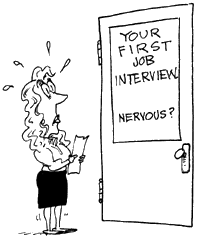
Ok, well we thought we have seen and heard it all in job interviews but  kids, here are  some of the absolute “do not do’s” on an interview. You might say after reading these, “no one would ever be that stupid”……well afraid so. Schools probably need to start teaching interview skills…Ya Think!

  1. Candidate said the more he was paid, the harder he worked
  2. Candidate said he had been fired from past positions, but still included those managers as references
  3. Candidate said getting an interview was important because he wanted an opportunity to show off his new tie
  4. Candidate listed her dog as a reference
  5. Candidate listed-yes, the moonwalk-as a special skill
  6. A husband and wife team looking to job share submitted a poem they had co-written
  7. Candidate listed ‘versatile toes’ as a selling point
  8. Candidate wrote that he would be “a good asset to the company” but somehow omitted the last two letters in “asset.”
  9. Candidate’s email address contained the phrase “shakinmybootie”
  10. Candidate mentioned that he had survived a bite from a deadly aquatic animal
  11. Candidate used first name only
  12. Candidate asked, “Would you pass up the opportunity to hire someone like this? I think not.”
  13. Candidate insisted that he be paid for the time he spent interviewing with the company
  14. Candidate shipped a lemon with resume, stating, “I am not a lemon.”
  15. Candidate included on his resume the fact that he had been arrested for assaulting his previous boss.

Filed Under: Management Insights

What Does Twitter have in Common with Old-School Advertising?

August 15, 2011

It’s the Headline! What?

Twitter has become the place for sharing content links. If your content catches attention on Twitter and spreads, suddenly you’re getting significant traffic from people who may have never visited your site before.

What you share on Twitter is not just about the actual value of the content. It’s also about whether the content gets viewed and appreciated in the first place.

… the difference is in the headline.

Your headline is the first, and perhaps only, impression you make on a prospective reader. Without a headline or post title that turns a browser into a reader, the rest of your words may as well not even exist.

Fact: On average, 8 out of 10 people will read a headline, but only 2 out of 10 will go on to read the content. (the old 80/20 Rule)  This is in a typical headline environment, such as a newspaper, magazine, or web page.

Now, think about a Twitter stream…

People are scanning more ruthlessly than ever, looking for interesting tidbits. Your content link is competing with conversations.

Some people will tell you that a good Twitter headline is as short as possible. This is due not only to the 140-character limit that Twitter imposes, but also because in order for your headline to spread, people need room to retweet it. Twitter culture dictates that you give credit to the person who originally exposed you to a tweet when you retweet, so extra space is needed.

The mistake: Too many people, however, focus on “short” and forget about the “as possible.”

A better way to think about it is as long as necessary, but no longer.

Enter the Return of the Short Headline

  • 95% of the most effective headlines from the early years of magazine advertising were eight words or less. This is because magazine copywriters had to write tight headlines due to space concerns, just like Twitter users.
  • Studies done from the direct mail industry show that about 50% to 60% of the most effective headlines are eight words or less, leaving ample indication that longer headlines work, too.
  • On a webpage, there are no space concerns, so web copywriters found that longer headlines communicated more benefit right at the top of the page where eye-tracking studies show people focus, and therefore worked better.

So, Twitter brings us back full-circle at a time when content is the new advertising. But it’s clear that a well-written short headline has power, especially when in a level-playing-field environment where everyone has the same constraints.

Time to up your headline game.

So what are the elements elements of solid headline writing?

Your headlines must:

  1. Be USEFUL to the reader,
  2. Provide him with a sense of URGENCY,
  3. Convey the idea that the main benefit is somehow UNIQUE; and
  4. Do all of the above in an ULTRA-SPECIFIC way.

More tips coming soon!

Filed Under: Current News, Marketing Insights

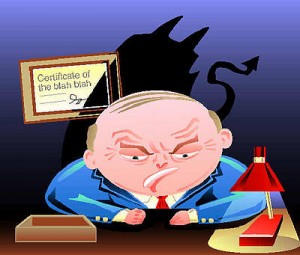
Is this your Boss?

August 12, 2011

What you don’t do can make as much or sometimes more impact than what you actually do — and can also say a lot about your leadership style and abilities as a manager.

Here a list of 5 “Do Not Do’s”….Is this your Boss?

  1. Deliver annual performance reviews.Annual or semi-annual appraisals waste everyone’s time. Years ago my review was late, so I mentioned it to my boss. He said, “I’ll get to it… but you realize you won’t learn a thing. You’ve already heard everything I will say, good or bad. If anything on your review comes as a surprise to you I haven’t done my job.” He was right. The best feedback isn’t scheduled; the best feedback happens on the spot when it makes the most impact, either as praise and encouragement or as training and suggestions for improvement. Waiting for a scheduled review is the lazy way out. Your job is to coach and mentor and develop — every day.
  2. Say, “Look… I’ve been meaning to apologize…” Apologies should be made on the spot, every time. You should never need to apologize for not having apologized sooner. When you mess up, ‘fess up.  Right away. Don’t you want employees to immediately tell you when they make a mistake? Model the same behavior.
  3. Hold meetings to solicit ideas. Many companies hold brainstorming sessions to solicit ideas for improvement, especially when times get tough. Sounds great — after all, you’re “engaging employees” and “valuing their contributions,” right? But you don’t need a meeting to get input. When employees know you listen they often bring ideas to you. Plus, the better way to ask for ideas is to talk to people individually and to be more specific. Say, “I wish we could find a way to get orders through our system faster. What would you change if you were me?” Trust me: Employees picture themselves doing your job — and doing your job better — all the time. They have ideas. Be open, act on good ideas, explain why less than good ideas aren’t feasible… and you’ll get all the input you can handle.
  4. Create development plans. Development plans are, like annual performance reviews, largely a corporate construct. (HR staffers love to monitor compliance and alert managers when supervisors are late turning in their employees’ development plans. Or maybe that’s just my experience.) You should know what each of your employees hopes to achieve: Skills and experience they want to gain, career paths they hope to take, etc. So talk about it — informally. Assign projects that fit. Provide training that fits. Create opportunities that fit. Then give feedback on the spot. “Develop” is a verb that requires action; “development” is a noun that sits in a file cabinet.
  5. Call in favors. I know lots of bosses who play the guilt game, like saying, “John, I’ve been very flexible with your schedule the last few months while your wife was sick… now I really need you to come through for me and work this weekend…” Generosity should always be a one-way street. Be flexible when it’s the right thing to do. Be accommodating when it’s the right thing to do. Never lend money to friends unless you don’t care if you are repaid, and never do “favors” for employees in anticipation of return. As a leader, only give — never take.

Filed Under: Management Insights

Branding Made Easy

August 8, 2011

Successful brands are anchored in propositions that are desirable, distinctive, and credible in people’s minds. Following are eight pieces of advice that anyone working with a competitive identity should know and put into practice. These concepts are key to developing a bond with consumers and fans, which is the essence of branding.

1 Stand out
Having a differentiated, relevant product is critical to success. Distinctive branding stems from clear brand positioning—knowing who the brand targets, what the competition is and how to beat it.

2 Stake your claim
The majority of leading brands got where they are by staking out a distinct territory and capitalizing on it. The ultimate measure of success? Discovering that your brand name is generic for its category, like Band-Aid, Google, Kleenex, or Xerox.

3 Find the insight
Sometimes the simple difference at the core of a brand is an obvious universal truth that no one has acted on. Great insights couple human need or desire with a market opportunity.

4 Keep your promise
Brands that resonate strongly with consumers are typically motivated by the desire to exceed expectations. Living up to your word not only builds brand loyalty, it also encourages word-of-mouth promotion.

5 Get emotional
However important rational claims may be, they cannot touch the powerful connection created by anchoring a brand in the psyche of the consumer. Nor can emotional ties be easily replicated by competitors.

6 Begin at home
An engaged and passionate workforce should not be overlooked as a highly effective mechanism for driving brand awareness. Firms that empower their employees to carry out the brand promise develop a network of passionate brand advocates.

7 Own your media
Relying on your own media to carry your message not only makes great financial sense, it also speaks to customers more directly than advertising can. This is an area that your competitors can neither access nor influence.

8 Start a dialogue
Old-world marketing involves a one-way flow of information from brand to consumer. Today’s savvy brands open the door for two-way communication through digital platforms and interactive experiences that help consumers bond with and even influence the products and services they favor.

Filed Under: Branding

Reasons why a Website Design a Fails

August 8, 2011

Everyone has witnessed really absurd website designs that instead of appealing, repel the visitor and force them to revert to a different page.

To design a good website, it is important that you have some knowledge about design conventions. Without knowing  about these conventions, you might  be able to create “at best” an interesting  web design. There are many “would be” designers that are doing that just – “creating interesting pretty websites”.

“In any competitive marketplace, the inability to differentiate will ultimately lead to obscurity”

  • Does your website  reinforce your businesses’ or personal professional identity in a competitive marketplace?
  • Does your website have the professional well established appearance that gives on-line customers confidence in your products or services?
  • Does your website have a creative impact that will get customers and clients excited and enthusiastic about you or your company? Professional creative and quality design is an important part of your investment to ensure a positive return.

If the answers to the above questions are “no” then your website may be failing you. Your website design may be failing to adhere to some basic, yet important,  important website design conventions. Some of the reasons why website designs fail are given below.

1. Lack of Balance

Balance is the basic premise when designing websites. Balance allows you to connect all elements of the website and create a proper flow. The balance might be symmetrical or asymmetrical. Symmetrical balance is based on equal weight to both sides resulting in a formal and traditional website. An asymmetrical balance means that all elements comprise of different weights leading to a unique and distinguishable website.

2. Use of Bevel and Emboss

New website designers typically use bevel and emboss a lot. This is because they believe that it will bring a nice effect to their website. However, this is not true. Bevel and emboss should not be abused, rather, these should be used sparingly so as to create an effect. Many useful tutorials exist that allow you to understand how you can transform emboss into a useful and strong technique. However, if you don’t really know how to use bevel and emboss, it is best that you avoid its usage.

3. Distracting Backgrounds

At times, people use backgrounds that are otherwise very appealing to the eye; however, when used as a background for the website, they may prove to be very distracting. Therefore, if you use a busy and heavy background, it will end up distracting the user. The user would lose the focus and the message of your website will be lost on the user. Therefore, do not use backgrounds that have a higher visual impact than your website. The users would feel that your website provides no specific information and they will leave the website very quickly.

4. Lack of Detail

Sometimes, users find a website useless because it lacks detail. If you think you have finished everything and covered every aspect of website designing, think again. You might be missing the detail of some minor things. Therefore, as a rule, always check the website design for small details.

5. White Space

White space is the space that is created between elements and is important in enhancing the readability and design flow of your website. It is also used to provide a clean look to the website making the website more readable.

Filed Under: Graphic Design

  • « Previous Page
  • 1
  • …
  • 23
  • 24
  • 25
  • 26
  • 27
  • …
  • 54
  • Next Page »

Delivering Customer Experience Excellence

Let's give em' something to talk about!

Contact Us

Copyright © 2026 · Archimedia Studios · Privacy Policy