Archimedia Studios

  • Home
  • Our Company
  • Expertise
  • Blog
  • Contact Us

Is this the Future of Sketching?

September 5, 2011

New stylus product from Wacom set to blur the line between traditional analogue and digital sketching…
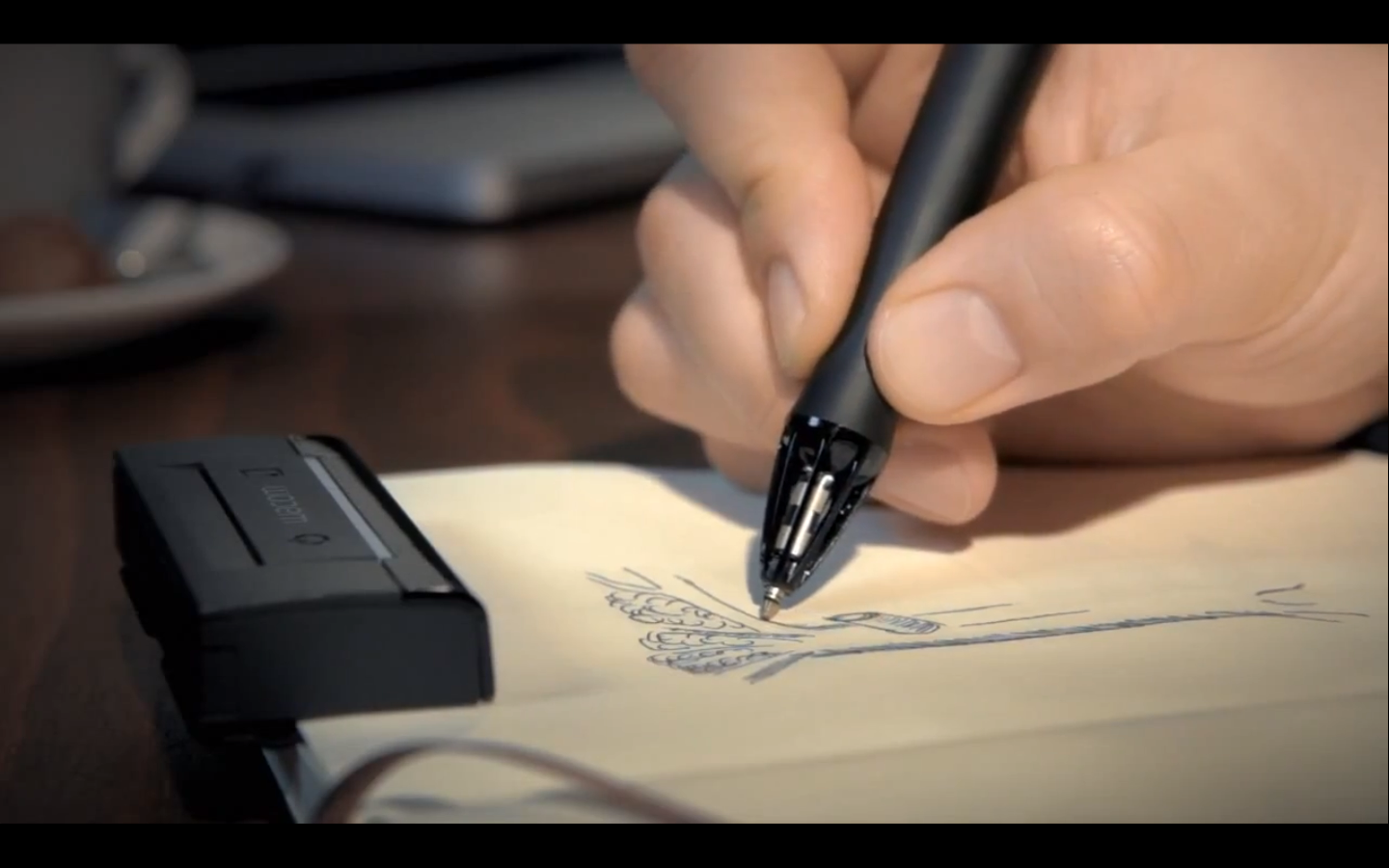
Sketching is perhaps the most liberating part of the design process, you are completely unrestrained by design software or computers. However often translating that form into a digital environment for tweaking and refinement isn’t so streamlined. Wacom’s new product is seeking to bridge that gap between ideation sketching and digital development and editing…

“The Inkling digital sketch pen captures a digital likeness of your work while you sketch with its ballpoint tip on any sketchbook or standard piece of paper. Designed for rough concepting and creative brainstorming, Inkling is ideal for the front end of the creative process…”

The major advantage of this product is the freedom to sketch away from the computer, away from the traditional Wacom type tablet), indoors or outdoors, but still quickly generate vector paths for drawings or laser cutting. Wacom have clearly demonstrated an understanding of the ubiquitous computing needs of designers, illustrators, makers, doodlers, etc..

The Inkling receiver has been built to be very versatile and can be clipped to any sketchbook or piece of paper. It employes infrared and ultrasonic technologies to pick up your hand sketches, these can be saved as either vector lines or pixels in a number of file formats.

“In addition to capturing your sketch, stroke by stroke, Inkling allows you to create layers in digital files while you sketch on paper. Digital files are transferred to your computer…”

This product cost about $199.00

Filed Under: Graphic Design

Should you use a softbox, or an umbrella?

September 4, 2011

Should you use a softbox, or an umbrella? Even though they serve similar purposes, which is to provide a larger light source (thereby softer light), there are several key differences between a softbox and an umbrella.

Softbox

This is the ideal light shaping tool for portraits, because of its versatility in controlling light spill. If you are shooting inside a small room, a softbox enables you to control the spill of light. This means that the subject (the person or object you are photographing) is illuminated in soft light, while the background (walls/ceiling/floor) receives minimal, if any, light spill or light contamination. This is useful for shooting portraits that require a darker or even pitch black background. Yes, you can even create a pitch black background without the use of a black backdrop.

A softbox makes creating flattering portraits very easy. You can use it as a key light, fill light or even a hair light. It all depends on the lighting conditions at the location you are shooting.

There are several types of very portable softboxes that you can get. Get the largest one available, as it produces the softest light.   The softbox has 2 baffles to filter and soften light even further.

Umbrella

The umbrella’s distinct advantage is portability and mobility. You can bring several umbrellas on an outdoor shoot without any inconvenience. When opened, they provide beautiful soft light, by converting your light (speedlight or a more powerful monolight with battery pack) to a larger light source.

What the umbrella lacks in comparison to a softbox is control of light spill. When used indoors, an umbrella lights up a large part of the room, decreasing your control over how dark your background can be.

There are also different types of umbrellas.

A shoot-through is a translucent white umbrella which your light shoots through and onto the subject. The umbrella shaft is pointed away from the subject, thereby reducing any chances of it accidentally injuring your subject.

The other type is a reflective umbrella, where your light shoots into, and then bounces back onto the subject. This type of umbrella inevitably has its shaft pointing at the subject, so you can’t really go in as close as a shoot-through umbrella would allow. The closer you get to the subject, the softer the light. As the light wraps around the subject, it reduces harsh shadows.

Filed Under: Photography

It’s not what you look at it’s what you see…

September 4, 2011

“It’s not what you look at that matters, it’s what you see.”

– Henry David Thoreau

While Thoreau did not say this about photography, it’s about the best advice you can give to someone in our profession.

Photography is not about pressing a button on a camera. It is about telling a story — communicating what you see when you look at your subject.

Same Subject, Different Stories

Different photographers can photograph the same subject but tell a different story. This is true for all types of photography.

For example, let’s say you are a sports photographer covering a basketball game. The game is very close; there is a lot of excitement in the game and on the sidelines.

As the clock winds down, another photographer might focus all his attention on the court. But you spot a player on the sidelines, waving a towel to cheer on his team, that captures the emotion of the game even better.

Or let’s say you are hiking in the mountains and see a stream surrounded by lush vegetation.

Another photographer might go with a wide shot, but this seems boring to you. So you find an interesting rock formation to place in the foreground, providing contrast and giving a stronger feel for where you are.

Or perhaps you decide to go with a detail or macro shot instead. Why photograph a whole tree when a single leaf tells your story?

Training Yourself to Notice

  • We should always be looking for pretty light, interesting juxtapositions, leading lines and other visually stimulating subjects.
  • At the same time, we should always be looking for stories to tell.
  • Peer inside a building with unusual windows. See if someone is looking out, or reading a book, or painting.
  • Walk through an old cemetery. Maybe you’ll find someone pressure-washing the headstones.
  • Drive alongside a long, winding white fence. Perhaps you’ll come across a horse being fed by its owner.

Always be observing. Always be looking for interesting subjects, and thinking about what elements would make your photos even better.

The more you do this, the more often you will come across these elements — because you have trained yourself to notice them.

Filed Under: Photography

A sign that your Marketing Strategy may be failing…

September 1, 2011

How can you tell that your marketing strategy may not be working well?

(answer) If you continually hear remarks that  you, your product or business is the “the best kept secret”.

Filed Under: Marketing Insights

Greatest Steve Jobs Marketing Moment

August 26, 2011

Few can argue the genius of Apple’s Steve Jobs. His passion, creativity and innovations will endure for generations. Through the years he has consistently demonstrated an “Outside the Box” approach to marketing which included; Opening Apple Stores, iTunes, digital storefronts (the App Store), to name just a few. However,  the “Think Different” campaign in our opinion was simply marketing and advertising tactical  brilliance.

Believe it or not, people once saw Apple as a washed-up relic of tech’s olden days, if they thought of the company at all. The dramatic Think Different campaign changed that forever. Its simple tribute to “the crazy ones” and footage of iconic celebrities, artists, and historical figures reminded the world Apple was here to stay while suggesting that, just maybe, a computer could be more than yet another box on your cubicle desk.

Filed Under: Marketing Insights

  • « Previous Page
  • 1
  • …
  • 22
  • 23
  • 24
  • 25
  • 26
  • …
  • 54
  • Next Page »

Delivering Customer Experience Excellence

Let's give em' something to talk about!

Contact Us

Copyright © 2026 · Archimedia Studios · Privacy Policy