Archimedia Studios

  • Home
  • Our Company
  • Expertise
  • Blog
  • Contact Us

Is it an image or video? No it’s a Cinemagraph

October 12, 2011

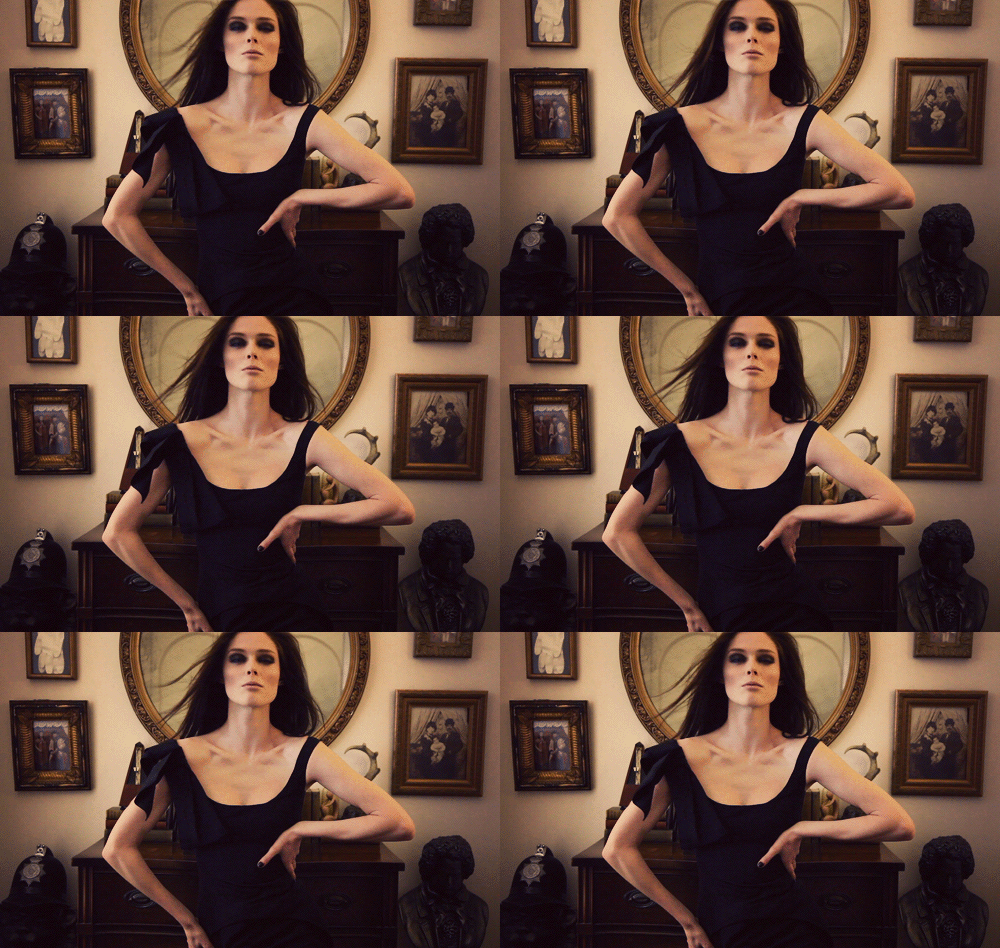
Cinemagraph is a technique of blending the effects of images and videos.

Essentially it’s a sophisticated and refined version of creating animated GIF’s with an artistic goal A big step from the dancing bunny and flashing lights that use to prevalent on websites a few years back. It was introduced by a New York fashion photographer Jamie Beck, in collaboration with motion graphics designer Kevin Burg.

In an upcoming post, we’ll tell you how to make one…check back!
Filed Under: Graphic Design

Not using Video…better think twice

October 7, 2011

Artists, bands and businesses…

IF…

  • You have yet to use video for your personal or business brand promotion
  • Say you don’t have the time to use it
  • Don’t have a video EPK?
  • Think you don’t need video in your marketing and branding strategies

You may Want to Think Twice about it.

Why ?…


1: 60%
The Internet is composed of over 60 percent video. Every minute another 24 hours of video is being uploaded onto YouTube and over 2 billion of those videos are being watched every day! There is no end in sight. YouTube and video on the Internet, in general, has created an audience expecting video. Artists and Businesses who ignore this fact are missing a huge opportunity to speak to a large portion of their target audience in a way that is more personal and effective in establishing relationships and brand loyalty .
2: 80% / 52%
Did you know that 80 percent of people who land on a website with video will watch the video? Of the 80 percent who watch the video, 52 percent of those viewers will take some form of action such as placing a phone call, subscribing to your list , dig further into your website, or even purchase your products and services.

3: #2
YouTube is the NUMBER 2 search engine on the Internet. This fact surprises most people. When talking about  search engines, most often, names like ‘Yahoo,’ ‘Bing,’ ‘Ask’ and, of course, ‘Google,’ who is the 800 pound gorilla of search engines come to mind.

Google, who purchased YouTube in 2006 for $1.65 billion, is primarily a text based search engine. With YouTube you can engage your target audience much more effectively through video than a text based ad could in the past. Chances are your target audience is now searching for you, your products or services on YouTube. If you don’t have a video marketing strategy that incorporates YouTube, your are putting yourself at a disadvantage.

The numbers game of  accumulating Facebook Friends/fans and Twitter followers is all well and good, but in today’s market, marketing directives are becoming more personalized.  Engagement, connection and story are the new forms of promotional art. Your fans and prospects want to  connect with YOU! Speaking through video creates a bond where fans and  prospects feel they get to know you, like you and trust you, beyond the daily faceless obligatory Tweets,  Facebook posts and music player widgets.  Thus they will be more apt to buy your music or products and more importantly become Loyal Fans not just a number.

Filed Under: Marketing Insights

Thursday’s Tips – Reclaiming Photoshop Real Estate

October 6, 2011

FULL SCREEN PHOTOSHOP

This is one of those shortcuts that once you know it, you may find yourself using it all the time

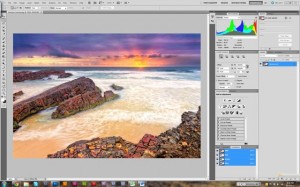
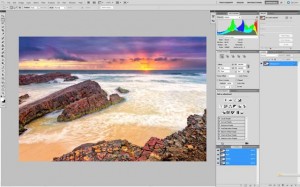
By simply pressing the F key inside of Photoshop you can cycle between Standard Screen Mode, Full screen(with menu bar) and Full Screen Mode – as seen below.

STANDARD SCREEN MODE

FULL SCREEN (WITH MENU BAR)

FULL SCREEN MODE

Full Screen (with menu bar) hides the start bar (on Windows) and desktop wallpaper (on Mac). This is useful for two reasons:

  1. You have more room to see/edit your photo
  2. The neutral grey background is better for making colour corrections or decisions relating to brightness and contrast

Full Screen Mode hides all tools, windows, start bars and desktop wallpapers so that you can concentrate on your image. This screen mode typically uses a black background however tr ychanging this to grey so that it doesn’t affect how you perceive colour and contrast. You can do this in the preferences menu.

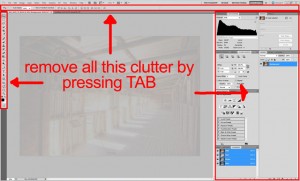
SHOW and HIDE PALETTES

The TAB button on your keyboard is a shortcut that toggles between showing or hiding the palettes, tools and options toolbar. It’s a simple and fast way to remove the clutter and get right into the action.

This shortcut is especially useful when zoomed in and doing high level retouching with the brush or clone tools because it gives you a larger area of the screen to work within. It is even more useful if you know other shortcuts because it means you can stay in this viewing mode without having to keep returning to the other windows.
Shortcut

  • WIN: Tab
  • MAC: Tab

BUT DID YOU KNOW?

You may be saying that you knew that one already. But did you know that Shift + TAB is the shortcut that only hides the windows or palettes on the right hand side of the screen?  So if you find that you don t need to access them all the time but still want to keep the tools and toolbox options available then Shift + TAB is the shortcut for you.

Filed Under: Graphic Design

Still the Oldest Trick in the Book?

October 3, 2011

Marketers and agencies have been using sex as an advertising tactic from day one, but does it really work?

Is it Sex that Sells or… is it  Attention that sells!

Getting people’s attention is the ultimate goal of putting attractive people in front of products to sell them. Advertisers will use many gimmicks to gain attention; humor, shock and awe and of course sex. But once you got this attention your product still has a lot of selling to do and the bigger issue to address…how do you earn the customers trust?

Successful companies are good at gaining attention and earning trust not just one or the other.We’re surrounded by advertisements that desperately compete for our attention. Everywhere we look, we find ourselves inevitably drawn to images of scantily clad attractive men and women that are supposed to somehow inspire us to purchase products they endorse. Sure, this attention-getting strategy is popular. But, is it effective?

Here is an example of a TV ad from the 1960s selling aftershave. Would it make you buy this aftershave?

Take a look at this modern day ad for Axe Body Spray. Notice the similarities, but still ask yourself would this ad make you buy this product?

http://youtu.be/I9tWZB7OUSU

The misuse of sex appeal, however,  can be costly to a brand. Many campaigns deemed offensive have started brand boycotts that affect sales and damage brand reputation. Abercrombie & Fitch and Calvin Klein have been involved in several such scandals

Sex in advertising has and will continue to stir  controversy for many years, an advertiser must be careful when incorporating it in a campaign. Great advertisers consider not only the attention-getting power of an advertisement or commercial, but also what kind of emotional response it provokes in customers. Studies show that the attractiveness of the endorsing model provokes positive responses. Nudity and graphic erotic content, while still increasing consumer’s attention, doesn’t really generate positive feelings among viewers. In other words, advertisers must be careful to avoid the “cheap shot,” which may negatively affect a brand’s image.

To avoid that, the sexual content in advertising should be appropriate to the product category and have a proper underlying message, not for just the sake of using it!  ..like the GoDaddy commercials, for example and this one by JC Penney.

What does footage of Phobe Cates at 18 years old have to do with JC Penney selling Van Heusen clothing?

Nothing you say…but did it get your attention?

Does the “sex sells” tactic show a higher return on investment?

With the birth of Internet and digital advertising, in the form of Google Adwords & Facebook Ads, we can now tell exactly when certain advertisements generate a return.  There are many more tools afforded to us today to measure  these Ad ROI’s

Let’s Take A Look At Facebook Advertisements

Here are some quick Facebook facts:

  1. More than 500 million active users
  2. 50% of active users log on to Facebook in any given day
  3. People spend over 700 billion minutes per month on Facebook

With that many active users, Facebook has become an emerging option for online advertising. Businesses can choose their target demographic and Facebook will display their ad to those users. In this new approach to advertising, can we still find marketers using ads that use sex to sell? Yes.

But Does Sex Really Sell?

According to somerecently conducted case studies more than 60% of users click on the ad that contains a female. The researcher showed samples of users’ 5 different pages of Facebook Ads that allotted to a total of over 200,000 page views.

Clicks are great, but did they sell?

In fact, these ads did. The campaigns showed that ads using “sex to sell ” performed with a high click through rate, but more importantly, the traffic converted into leads.

What should you do?

If you have a small picture framing company, should you go out and hire a bikini model for your ads? Of course not!

Our Commentary

It is our belief and experience that when advertising agencies cannot think of a good concept, they try and get hold of a celebrity. When the client cannot afford a celebrity, they get a skimpily clad woman instead. Conversely, as long as money is being generated from ads containing sexual content, you will continue to see them. This is not the only answer, for it it was all ads would contain sexual content and be void of innovation and imagination. We would have never seen some of the crestivity thst we have seen over the hyears from compaines such as Coca Cola, Budweiser and the latest E-trade commercials.

Remember the following:

  • All ad and marketing campaigns must be thought out with your brands image at the forefront.
  • Your goals in advertising is first to create attention to your product. But remember it is customer trust and loyalty to your product that will ultimately generate sales.
  • If an agency presents a campaign in front of you the incorporates the “sex sells”  tactic.  Question them on;
    • How many different approaches did they consider? (remember, more often than not, the “sex sells” approach is the easy way out)
    • Is the use of sexual content appropriate to your product category?
    • How will this tactic enhance your brand, build customer trust?

If you are not comfortable with the answers that you receive, then it may be time to seek out a new agency. Contact Us!

Filed Under: Advertising

Work those Lines!

September 27, 2011

In Design, you should always be encouraged to take a good look at the  lines in a photograph that you’re trying to combine with text and graphics.

Repetition is one of the most important design principles and this is a natural implementation of that idea. By analyzing the photo and following its directionality, you sometimes can find incredibly easy ways to make your graphics and text look truly integrated, as if the image was created expressly for the purpose you’re using it for, a great illusion !

The first step using the lines in a photo is to analyze the image’s content and use any hard lines to help align your artwork in a very literal fashion.

It is important to note that not every image will lend itself to the technique. However, learning to be more aware of how the existing content in a photograph can be used to guide and inspire you to create unique designs that break away from the cookie cutter mold that’s so easy to fall into.

Let’s take a look using first,  some easy analysis

The bricks in this photo form natural blocks. Headlines are set conventionally and stacked, making complimentary blocks.

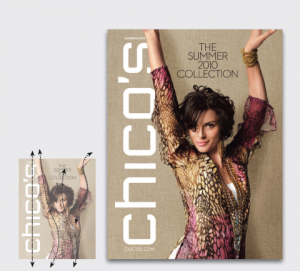
Next , a long tail blouse, plunging V-neck, and a sweeping, fluid pose yield a beautiful sleek top-to-bottom line which gets amplified by the vertical nameplate.

www.chicos.com

Lastly, we’ll be using a method that’s very similar to the repetition methods above, but in a more complex manner.

If we think about the strongest natural lines in this photo (below), they don’t really stretch across the image like those in the previous examples. Instead, we see a very defined pyramid take shape.

We can use this shape as inspiration for how we place our text on the page, just as we did with the bird photo. To do this, draw the lines that make up the triangle, then copy that triangle and place it in the area to the left. Finally, use this new triangle as a guide for text placement.

Notice that, in the final result below, we didn’t actually continue the pyramid shape all the way to the bottom. Instead, my lines of text seemed to naturally conform to an almost diamond shape, and that’s completely acceptable. Once again, you’re making the rules here so feel free to distort and rethink the natural lines in the photo rather than simply taking them so literally.

Photographs by Daniel Zedda

Filed Under: Graphic Design

  • « Previous Page
  • 1
  • …
  • 19
  • 20
  • 21
  • 22
  • 23
  • …
  • 54
  • Next Page »

Delivering Customer Experience Excellence

Let's give em' something to talk about!

Contact Us

Copyright © 2026 · Archimedia Studios · Privacy Policy