 One of our favorite marketing sayings is:
“If you can’t measure it, you can’t improve it”
Below are what we feel are best practices in marketing analytics and measuring and improving marketing ROI.
One of our favorite marketing sayings is:Below are what we feel are best practices in marketing analytics and measuring and improving marketing ROI.
 Brand identity is the outward expression of a brand, including its name, trademark, communications, promotion, and visual appearance. Because you develop the brand identity, it will reflect how you want the consumer to perceive the brand, the company, and the product or service. Don’t confuse this with the very important brand image.
The brand image is your customer’s mental picture of your brand. If you have executed your strategic marketing plan properly, the customer will have a brand image similar to what you attempt to project.
 What is a brand?
What does a brand do for you?
Why do you need a brand; or do you need a brand?
How can a brand help drive business your way?
Is all of this talk of brand overblown?
Think of your company, what is its brand, how do customers know you? What do you stand for? How can you improve your company’s perception?
A brand is the cornerstone or anchor point of your customer experience, it seasons all dialogue about your organization, and it focuses your advertising efforts and promotional activity. The positioning and strength of your marketing framework flows from your brand. A strong brand is about truth and it must tie into your company’s strengths. A brand creates a distinctive and durable perception in the minds of consumers. It’s a unique business identity intertwined with associations of personality, quality, and desire.
Think of a brand as a structure that holds your customer’s goodwill and your reputation. It’s your company’s identity and for what you stand. A brand can change the positioning of your product or service from a commodity, to a premium product or service so instead of appealing to low-price shoppers you attract buyers willing to pay more for your goods than for those of competitors. Ask yourself this, why do people willingly pay $3.00 bottle for water when they can get it free from the tap? That’s what a brand can do for you.
People particularly like brands they know; they feel comfortable buying a brand named product. Cadillac and Mercedes Benz have been fighting for the number one spot in the luxury car market for years, and then along came Lexus a few years ago and it has slowly chiseled away at their market. A few years ago, you might not have considered buying a Lexus but now, it has become a recognized luxury brand.
Branding your business works. Visit a local supermarket and look at the generic labels. If you check the generic brand of canned corn, compared to Green Giant brand, you will see the black and white label priced much lower. If you look at the nutritional label, you will find out that there is no difference what so ever. However, the brand name sells equal to or better than the generic one because people will pay a premium price for a known brand because consumers perceive it as better.
It takes time, money, and effort to build a brand name from scratch. Franchising is big business; people will pay large fees to purchase brand named businesses. Think of McDonalds, 7-11 stores, True Value, Do-It-Best, HobbyTown USA, and many others, people buy into these franchises, because they are a known brand with a business plan that all but guarantees success.

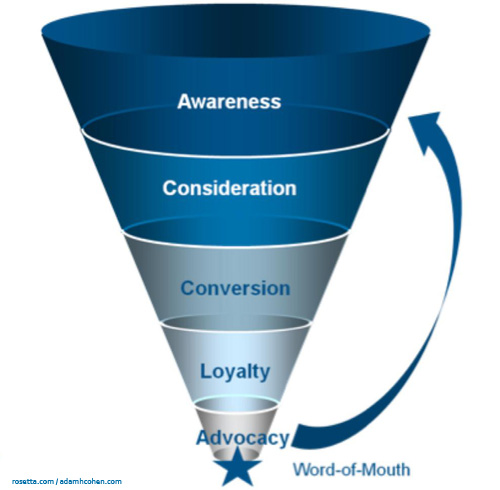
 The world has changed. We are in the midst of an unprecedented shift of power to the consumer fueled by the virtual megaphone handed to them through social media outlets. When a customer is angry or has a bad experience with a product or service, the old rule of thumb was that they told an average of 10 people about it. In today’s world some could easily be telling 10,000 (or more!). On the flip side, happy customers can be telling many more than the old average of 3 people about their good experience. Marketing executives just need to design initiatives that enable and activate them to do so. That shift can be represented through adapting one of every marketer’s favorite marketing conceptual frameworks, the funnel.
Infusing Engagement into the Marketing Funnel
With the expansion of the marketer’s toolbox to include social media, marketing is no longer about pushing out one way communications. The marketing world is no longer defined solely by impressions; it’s now a world of interactions. Today’s marketing includes the customer’s voice throughout the process, whether it’s intentional or not. Customers will talk online and comment on a brand’s marketing campaigns, products, services, and even how a company treats employees. It’s not enough to think about how companies communicate outwards; it’s just as important to think about how customers can communicate back, with each other, and arguably most importantly, with new prospects.
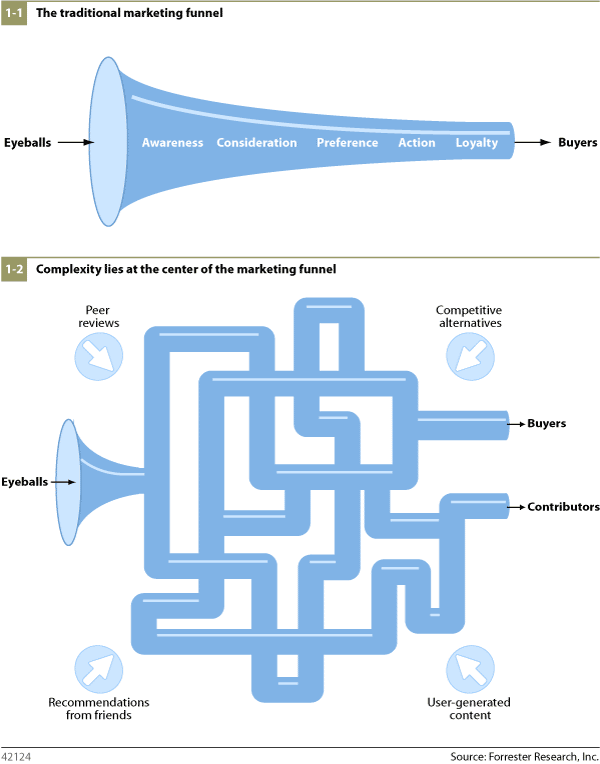
A few years ago, Forrester Research published a report on “engagement” and suggested that the marketing funnel has become much more complex in today’s environment. (See image. While the influencing factors are more complicated, the same simple, visual framework as the traditional marketing funnel can be leveraged to show this complexity. The design needs to account for engagement throughout the process rather than looking at it through a lens of static messages we push out.
For example, traditionally, marketers look to create awareness by placing carefully planned messages across appropriate media outlets. Today, customers can create and spread their own messages about a brand through user-generated content and social networks. Traditionally, marketers would hope to influence customers in the “consideration” phase through strategic promotions and sales tactics. Today, user-generated ratings and reviews are frequently enough to convince a customer to make the purchase. Building loyalty is no longer just about loyalty points programs for repeat purchase or sending regular emails to customers. Building loyalty now means entering into a dialogue with them and letting customers participate in more meaningful ways than static customer feedback surveys or a constant barrage of emails announcing special promotions.
Extending the Marketing Funnel
The old marketing funnel generally followed some version of this pattern:
With the widespread adoption of Customer Relationship Management (CRM) in the 1990’s, marketers began focusing more on loyalty or customer retention and brought the funnel one level deeper. The customer’s voice was considered important, but only in the context of customer service and a closed feedback loop. The old thinking was that sending customers regular emails would keep the brand top of mind and that special offers would keep customers from switching to competitors.
As mentioned before, today’s marketers will need to build a more authentic, deeper relationship with customers by truly engaging them to earn their loyalty—and this is how companies can begin to cultivate advocates.
It’s time to extend the marketing funnel one level deeper to account for advocacy. There are two reasons that cultivating and enabling advocacy is critical in today’s world:
Cultivating and enabling advocates will generate authentic word-of-mouth, bringing the best new customer prospects into the marketing funnel. The ROI on that? Priceless.