Archimedia Studios

  • Home
  • Our Company
  • Expertise
  • Blog
  • Contact Us

Movie Stars must now be marketers

June 11, 2012

Channing Tatum, Kurt Russell and movie stars of today and yesteryear are no longer just actors, but marketers as well.

Hollywood agents, marketing executives, financiers and other industry experts now stress that filmmakers and actors have no choice but to get involved from start to finish in a project, especially when it comes to marketing.

In today’s film industry, an actor who won’t pump a movie,  won’t get as much work.

Studios have always used stars to promote films, but in the age of social media, the methods of promotion have diversified, increasing the demands on many actors.

A decade ago, stars like Al Pacino or Kurt Russell often resisted showing up at a theater for a movie opening – let alone tweeting their whereabouts.

That star attitude is now outdated, as studios look for any way to build a dedicated audience. It has become  increasingly important to set a film up with a community that wants to own it in order to maximize the success potential of the project.

The myth is that a movie happens so fast you can start building your audience later.  The fact is, to compete in today’s market where the consumer has so many choices , you need to start marketing  and finding ownership of an audience at  both casting and script green lighting.

Here’s just one example of this process.

For the movie “21 Jump Street,” Sony staged a contest on Twitter between stars Channing Tatum and Jonah Hill to gain the most followers over a set period of time. The winner would release the trailer on Facebook.


 

Filed Under: Marketing Insights

Archimedia’s “Featured Artist” Shelby Ellis-Maguire

June 1, 2012

Our “Featured Artist” this week  is 16 year old singer/songwriter from the U.K,  Shelby Ellis-Maguire .

At just 16 years of age, this gifted artist penned “Speed of Life”, a song  that blends meaningful, mature lyrics with a melody that enhances the emotional qualities of the song.  Shelby’s very cool vocal texture lends to capture the feelings of her listeners, with a natural authenticity and sincerity that culminates in a disarmingly compelling performance and musical expression.

Shelby is an artist with talent, originality and a captivating presence We are looking forward with great interest in what her future efforts will bring.

Archimedia’s Featured Artist recognition seeks to bring an industry spotlight to un-signed  talent that we feel has true originality and  star potential.


Filed Under: Current News

Financing a hit pop song

May 28, 2012

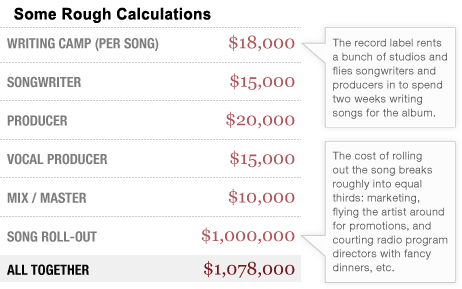
Getting a song on the pop charts takes big money from a label. While we recognize that there are other scenarios in which a song can become a hit, we are presenting what is a typical Label’s  process in producing a pop hit.


The Writing Camp

Often the process begins with a writing camp where a record label hires the best music writers in the country and drops them into the nicest recording studios in town for about two weeks. “It’s like an all-star game!”

Here’s who shows up at a writing camp: songwriters with no music, and producers toting music tracks with no words.

At a typical writing camp, the label might rent out 10 studios, at a total cost of about $25,000 a day.

A writing camp is like a reality show, where top chefs who have never met are forced to cook together. At the end, the artist shows up like the celebrity judge and picks their favorites.

Thus, to produce an album with 11 songs , a writing camp cost about $18,000 per song.

The songwriter and the producer each got a fee for their services. even before the artist even steps into the studio with their vocal producer.

The Vocal Producer

The vocal producer’s job is to make sure the artist sings the song right.

Not only that, the vocal producer has to deal with the artist’s rider. The rider is whatever the artist needs to get them in the mood to get into the booth and sing.

A typical vocal producer fee starts at $10,000 to $15,000 per song.


Mixing and Mastering

The last step is mixing and mastering the song, which costs another $10,000 to $15,000

Rough cost tally thus far;

The cost of the writing camp, plus fees for the songwriter, producer, vocal producer and the mix comes to $78,000.


We’re not done yet – Marketing and Promotion

But it’s not a hit until everybody hears it. How much does that cost?

About $1 million, according to many industry insiders.

The reason it costs so much is because your marketing has the click all at once; radio, TV, posters, promotions,  Billboard charting,  the iTunes chart, That’s what a hit song is: It’s everywhere you look. To get it there, the label pays.

Every song is different. Some songs have a momentum all their own, some songs just break out of the blue. But the record industry depends on hits for sales. Having hits is the business plan. The majority of songs that are hits — that chart high, that sell big, that blast out of cars in the summertime— cost a million bucks to get them heard and played and bought.

A typical breakdown of expenses is  roughly: a third for marketing, a third to fly the artist everywhere, and a third for radio.

“Marketing and radio are totally different; Marketing is street teams, commercials and ads. Radio is the cost to establish relationships with radio stations to get your song pushed and added to more spots on a radio playlist.


Filed Under: Marketing Insights

Is Vogue’s ban on ultra thin photos genuine?

May 17, 2012

Vogue’s 19 international editions will no longer feature photos of fashion models who “appear to have an eating disorder,” the magazine’s editors announced recently.

The Vogue editors said that beginning in June, editions in America, France, Britain and China, for starters, will no longer feature models with visible signs of eating disorders. It also suggested that fashion designers should stop creating “unrealistically” small samples that won’t fit anyone who isn’t ultra-thin.

“Vogue believes that good health is beautiful. Vogue editors around the world want the magazines to reflect their commitment to the health of the models who appear on the pages and the well-being of their readers,” said Conde Nast International chairman Jonathan Newhouse in a statement.

If you are a cynical to believe that Vogue’s promise is genuine, then you may view Vogue’s move as grandstanding, trying to appease an audience that is getting ever more savvy and tired of the tricks of the trade.  Is it cynical to ask the question why the fashion magazine failed to talk about the practice of digitally altering photos, a widespread practice that promotes an impossible standard of beauty?  Will they start with a non ultra thin model (keeping their promise)  and  then Photoshop them into a disturbingly thin model?

Extremely thin girls have been the ideal in fashion for years — and this may be the most push-back against the super thin movement we’ve seen in a decade. So if you really are sick of it, Vogue editors, actually do something about it. Stop talking about it, stop drawing up toothless guidelines that fit into tidy press releases, and just prove it. Don’t call in the tiny clothing samples for shoots. Don’t hire girls who are so thin you wonder if they have eating disorders. Don’t use Photoshop in the post production to digitally achieve that unrealistic thin look. Don’t only shoot Adele from the neck up.

We all hope that Vogue’s proposed new bold stance is genuine for Vogue has the power to make and break — whether its fashion trends, designers, models and yes, even industry practices. Others will follow.

More than 24 million Americans, both females and males, have an eating disorder. And eating disorders have the highest mortality rate of any mental illness, according to the National Association of Anorexia Nervosa and Associated Disorders.

Filed Under: Advertising

YouTube view counts, the game is changing

May 14, 2012

After investing $100 million to create content channels, YouTube’s focus has shifted from directing viewers to videos of skateboarding dogs to enticing them into longer, more engaging videos—the kind that are, not incidentally, more appealing to advertisers.

On March 15, YouTube altered its recommendation system to make the time spent with a video or channel a stronger indicator than a click in determining which videos to surface to a user. Google’s goal is clrearly that they want users to watch more and click less.

Before the change, YouTube would track the length of views up to 30 seconds, primarily to make sure each click led to an actual view. Now it’s tracking across longer timeframes to see if viewers watched two or three minutes of content.

It appears to be working. While views have dropped of late (Since December, views on YouTube have dropped 28%), however, the amount of minutes users spend watching YouTube has grown over the past year by 57% to more than 61 billion minutes in March 2012, according to ComScore. The average length of a video view has grown a full minute to four minutes in the past year.

There’s a business reason at play. Longer viewing means more opportunity to show viewers ads, either through strings of videos that play automatically with ads in between or longer videos with TV-like breaks. And engaged viewers are also thought to be in a more receptive mind-set for brand advertising, the biggest slice of ad dollars untapped by YouTube.

Brand advertisers are more concerned with notions such as engagement than they are by traditional web-based direct-response metrics such as clicks, said Eli Goodman, media evangelist at ComScore. “The effectiveness of advertising is enhanced when someone is in an engaged state.”

YouTube is also experimenting with more technology to decide when to show a user a video ad. Previously, that had been about once every seven minutes. Now, YouTube is using hundreds of variables to determine whether or not a viewer is engaged with a channel and likely to stick with it.

Filed Under: Advertising, Branding

  • « Previous Page
  • 1
  • …
  • 26
  • 27
  • 28
  • 29
  • 30
  • …
  • 71
  • Next Page »

Most Recent

  • Marvel’s Doctor Strange kicks Off The Blockbuster Season With A Magical $185M Opening
  • Disney Marvel’s ‘Shang-Chi’ Shatters Labor Day Box Office Record
  • Marvel’s ‘Black Widow’ Debuts With $80 Million in Theaters, $60 Million on Disney Plus
  • Latest List Of Upcoming Marvel Movies
  • Walt Disney Studios Announces Updated Release Schedule

Archives

Delivering Customer Experience Excellence

Let's give em' something to talk about!

Contact Us

  • Facebook
  • LinkedIn
  • Twitter

Copyright © 2026 · Archimedia Studios · Privacy Policy